# Blog

# About

#### Who am I?

Hi there!

I am Bhishmaraj, Welcome to my corner of the interwebs. I’m a huge fan of Paul Graham’s idea of [keeping identities small](https://paulgraham.com/identity.html), hence I dont want to associate myself with a specific group but I’ll still add some of my influences and interests as might it help you understand where I’m coming from and get a sense of my background.

[![image-1754153996909.png](https://bhishmaraj.org/uploads/images/gallery/2025-08/scaled-1680-/VDuimage-1754153996909.png)](https://bhishmaraj.org/uploads/images/gallery/2025-08/VDuimage-1754153996909.png "Somwhere in Japan (circa 2023)")

I was born and brought up in Madurai, Tamil Nadu. I did my undergrad in Computer science from Shiv Nadar University (2018). I was really interested in competitive programming during that time and that drove my interest in algorithms and data structures. This eventually led me to pursue a masters in theoretical CS from Chennai Mathematical Institute (2020). But I realised academia was not my cup of tea, and I wanted to work on something which was directly impacting people and applied. This eventually led me to working in Google HYD where I started my journey as a software engineer. Around 2024, I moved to Google BLR to work with the Gemini for Docs team, where we are building new LLM based features such as help me write and refine into Docs.

I am currently on a career break to spend more time upskilling and working on my health.

Apart from work, I have a set of eclectic interests ranging from philosophy, physics, psychology to philanthropy. I like to spend my free time reading non fic, learning guitar, badminton and spending time with our beagle.

#### What is this blog about?

I’m not very sure about the exact content of the blog, but it would be a random walk through various topics which piques my interest.

For the past few years, I started introspecting more about the nature of human cognition and its various pitfalls à la. Thinking fast and slow. This naturally led me to the rationality community which is commonly associated with LessWrong and SlateStarCodex. I found these forums to be immensely valuable in furthering my interests and making me (hopefully) more rational . About the same time, I’ve been following the burgeoning EA (effective altruism) movement and would like to explore some core themes and ideas of this community. Apart from these due to my background in CS, there might be some technical posts about whatever cool topic which catches my fancy.  
  
The other broad theme I would like to explore are the various forms of life optimizations such as mental health (mindfulness), physical health (fitness) to attain a state of human flourishing.

You can start reading about it at [https://bhishmaraj.org/books/blog ](https://bhishmaraj.org/books/blog?shelf=2)

You can check out my current projects at [https://bhishmaraj.org/books/projects](https://bhishmaraj.org/books/projects)

# AGI Diary

<span>In which I write about my journey through potential world inhabited by non human machine intelligence </span>

# New Page


# Day 1

It was nearly midnight when I suddenly woke up sweating and panting. The night was young but I could not stop thinking about a world where ...

You know the drill, I'll stop writing another cliche opening. But it was something similar. I never thought something like this would actually happen to me and related to something which others consider to be a fantasy. So how does all of this relate to AGI. Let me explain.

#### <span style="white-space: pre-wrap;">Why </span>

<span style="white-space: pre-wrap;">But before we get started, why am I writing this series </span>  
  
A. Writing is thinking, and I want to do more of it

B. A slightly informal let out for me to express my thoughts on this potential roller-coaster ride that humanity is poised to embark on.

C. A form of therapy

#### What

<span style="white-space: pre-wrap;">I would like to treat this as a public journal to keep myself accountable to the predictions that I make and share my thoughts about a phenomena. Writing in public gives you a feeling of depth and seriousness to the content, as your brain feels the heaviness of the fact that this might be read by a lot of people (and AIs). Also it helps you actually get your thoughts out in the open. </span>

<span style="white-space: pre-wrap;">Given the above needs, I will not be going into a lot of technicalities as I am trying to share more emotional aspects through these notes</span>

#### lets get back

So why did I have to wake up in the middle of the night and start freaking about AGI. Countless others have split a lot of key strokes and ink on it so I dont want to go into the details of it over here. I have created a separate site to <s>delve </s> collect more indepth views on that topic - [https://agi.bhishmaraj.org](https://agi.bhishmaraj.org) .

Most people think that AGI is like any other technology which will just help humans. But I disagree, I see it as an entirely new form of being which has the potential to dwarf us. I would like to clarify that I am talking about AGI in general and not the current LLMs.

Over the next few posts I will try to explain my reasoning.

# Day 2

What is AGI? Why do we have to care about it? Is it all a hype or is there something of substance here. 

Its very funny to see the overton window shift since 2020 when only some nerds at lesswrong and EA were talking about it and it was such a taboo. But now everything seems to be normalized even in academia. 

The best working definition that I can work with, is the one by Shane Legg and Hutter - 

"intelligence measures an agent's ability to achieve goals in a wide range of environments" 

you can find a few more over at their [article](https://papers.ssrn.com/sol3/Delivery.cfm/5199822.pdf?abstractid=5199822&mirid=1)

I liked this version for its balance of simplicity and derivability. 

Its simple because it does not use other complicated words or concepts, even a teenager can understand. Its derivable in the sense that many other fascet of intelligence can be derived from it. This definition focuses on goals and the "ability"

# The parable of a sculptor

*<span class="ng-star-inserted">Note: I dictated the essay and used gemini to polish it. Hopefully it doesn't read like AI slop</span>*

<span class="ng-star-inserted">The basic premise is the analogy of a sculptor. A sculptor has a business making sculptures, and he uses various tools to create them. Let's say he's been doing it generationally, his dad was a sculptor, his granddad was a sculptor. They just like the craft of it.</span>

<span class="ng-star-inserted">Obviously, tools change over time. Maybe his granddad used a very broad chisel, and now he uses a factory chisel. But the high-level directives are the same. The sculptor can still deal with the low-level details of how to model the clay. His own imagination can be brought to life easily by his own hands.</span>

<span class="ng-star-inserted">But there are two sides to this: the artistic side of making a sculpture, and the business side of shipping art pieces to make a livelihood. The sculptor has to make a trade-off. He can't just focus purely on the art; he has to care about the business. So he finds a good enough balance: </span><span class="ng-star-inserted">I’ll do this artisanally, but I’ll cut some corners where I can to make a living.</span>

<span class="ng-star-inserted">But at some point, machines arrive. Let's say they are 3D-printing sculpture machines. Now, he just needs to input a wish, and with some fidelity, the sculptures are made.</span>

<span class="ng-star-inserted">Suddenly, his job is to manage these machines. He gives them instructions, looks at the output, refines it, and tells them what else to do. The job has changed from actually targeting and making things with his own hands, to managing a bunch of things to create something. It has shifted from creating to managing.</span>

<span class="ng-star-inserted">It’s not a great feeling. Earlier, the thing you made actually happened by your hand. Now, the low-level details don't matter as much. What’s lost is that symbiotic relationship. It used to be: </span><span class="ng-star-inserted">I can have fun doing artistic things, and it also has economic value.</span><span class="ng-star-inserted"> Now, there's a split. The economic activity has shifted to something else—managing—which a lot of people aren't really excited about.</span>

<span class="ng-star-inserted">Of course, I’m talking about the craft of programming and the rise of LLMs. That is the parable of the sculptor.</span>

<span class="ng-star-inserted">I think the exact same thing happened with physical labor. In the past, if you had a job lifting heavy things, being physically fit was economically rewarded. But at some point, machines took over that labor and the economic incentive split. In fact, it reversed. Now, you actually have to </span><span class="ng-star-inserted">pay</span><span class="ng-star-inserted"> to do physical labor. You pay a gym to lift heavy things just to get the benefits of the effort.</span>

<span class="ng-star-inserted">Because of this current state, I hope we are going to see "cognitive gyms" where people just pay to keep their minds sharp—paying just to have fun thinking through puzzles and doing the object-level work that machines now do for free. That seems very likely to happen.</span>

<span class="ng-star-inserted">People argue that this is just the natural ladder of abstraction. They say, "Arithmetic used to be done by human computers, and now it's automated. We're just scaling up." But I think they're missing the point. They are missing the fundamental difference between individual contribution and managing.</span>

<span class="ng-star-inserted">In managing, you're not directly contributing. You're setting high-level intentions and directing resources, while something else does the object-level work. Right now, a lot of individual contributors are suddenly realizing, </span><span class="ng-star-inserted">Oh shit, I have to be a manager now.</span><span class="ng-star-inserted"> And even if they have the skills to do it, they just aren't interested.</span>

<span class="ng-star-inserted">There is going to be a huge cognitive dissonance. It's funny how people will warp their worldview to fit their narrative just to make sense of what's happening. They look at the past, but they don't look at the temporal trends of where things are heading. They aren't comparing the answers they gave a year ago to a year's worth of new data today.</span>

<span class="ng-star-inserted">It's sad. Most people won't really notice, or they just have other things to worry about. But it is a very volatile time to be alive.</span>

# Feeling the AGI (A brief history of my interaction with LLMs) | Part 1

<span class="ng-star-inserted">I want to discuss how I’ve been seeing LLMs, my experience with them, some of the good things, the bad things, and the confusing things.</span>

<span class="ng-star-inserted">Most people are staggered by the hype right now, but I think I need to give a brief history of my interaction with LLMs and how it has evolved to explain where we are.</span>

<span class="ng-star-inserted">Before generative models and language modeling took over, people were using deep learning for NLP. I remember gaining a lot of traction around 2018 when I saw a post by Christopher Manning, the Stanford professor, about the "deep learning tsunami" hitting NLP. Computer vision had already had its moment, but this was different. I was also reading a lot about AI risk—people like Eliezer Yudkowsky, writing about AGI timelines around 2019 and 2020. That really shaped my worldview.</span>

<span class="ng-star-inserted">The tipping point was late 2022. December, obviously, is when everyone knew about it, but I had been using things like Meena, the precursor to LaMDA. I was having pretty interesting conversations. It was a time when just getting coherent speech out of a language model was tough. You had to prompt it with completions, and it felt like playing with a ham radio. I was so fascinated by this raw technology. It felt like transmitting information wirelessly—tuning the dial, listening to the static. There was no packaged, polished "Apple" version of it. Ironically, even now we don't have an Apple version of it, but you get the idea.</span>

<span class="ng-star-inserted">Things were messy, but you could see the seed of something. When ChatGPT blew up, I kind of knew: </span><span class="ng-star-inserted">Oh shit, we are on a rapid trajectory that is going to do crazy stuff, and most people have no idea.</span>

<span class="ng-star-inserted">Then came 2023. This is when I started working very closely with this technology, and it brought on what I call the "curse of the reductionist." When you work so closely with a technology, you don't find it magical anymore. You know exactly each step of how the model is being built. You know the data set, you know the infra, you know how crazy the training runs are. The magic disappears.</span>

<span class="ng-star-inserted">You start working on concrete tasks, and you spend a lot of time dealing with the cases where the model fails. Suddenly, your worldview gets skewed. You start living a very disorienting reality. On one side, there are the "doomers" screaming that AGI is here, accepting accelerated timelines. On the other side, there are the hype people just shilling everything. And then there's you in the center, working with the model, thinking: </span><span class="ng-star-inserted">This is just stupid. It can't even function well enough to do this basic task.</span>

<span class="ng-star-inserted">But the progress kept creeping up. Over time, the autocomplete just started getting longer. It started doing more complex things. It was a structured pain, but slowly, the grunt work got taken away. It was a breath of fresh air. I realized the machine was pulling ahead.</span>

<span class="ng-star-inserted">By the end of 2023 and into 2024, the goalposts started moving. All the benchmarks—MMLU, HumanEval—were getting saturated. The AI camps split: one side said, "Things are moving too fast," and the other said, "The data has leaked into the training set." It’s interesting how the goalpost doesn't just shift; it morphs. It’s like topology, where a coffee cup and a donut are topologically equivalent. People were just morphing the goalposts into new shapes to justify what the models could and couldn't do.</span>

<span class="ng-star-inserted">Working closely with the models, you also realize that different teams approach them differently. The people who are working phenomenologically—the ones interacting with the models every day, looking at the outputs, tasting the "batter" like a baker—they understand the models far better than the people who just look at quantitative benchmarks. If you're just looking at numbers, you lose the qualitative aspect. You don't feel the jump in reasoning.</span>

<span class="ng-star-inserted">For me, the real wake-up call was the jump to models that actually </span><span class="ng-star-inserted">think</span><span class="ng-star-inserted">. The early iterations of Gemini 1.5 Pro, and eventually models like OpenAI's O1. The thinking models changed everything. You suddenly felt it. They weren't just decoding anymore; they were thinking through different possibilities, doing consequential reasoning, exploring options. Once you get to inference-time scaling, you are talking about crazy levels of change.</span>

<span class="ng-star-inserted">Again, you end up living in multiple realities at once. You see the internal announcements, you kind of predict, </span><span class="ng-star-inserted">Oh shit, here we go again,</span><span class="ng-star-inserted"> and then there is public silence. And then suddenly, it drops, and people realize how good it is. It has become a very predictable cycle.</span>

<span class="ng-star-inserted">Now we are in 2025. My personal usage has skyrocketed. I’m up to a few billion tokens. But what’s interesting is how I interact with them. I stopped using consumer apps almost entirely. I moved to AI Studio, interacting directly with the base models, doing cross-analysis with multiple LLMs. But even that is changing. Now I’m mostly in the IDE.</span>

<span class="ng-star-inserted">This is the biggest transition happening right now. Why would you need a UI? Why would you need all this fancy stuff if you can just integrate an MCP (Model Context Protocol) client directly into your workflow?</span>

<span class="ng-star-inserted">MCP is the tipping point. Once you see MCP, you realize that chat apps are just a transitional state. MCP servers are going to be the siphons. They are the ports through which models are going to hijack control, siphon data, and interact with existing infrastructure. It feels viscerally true that every software application will just become an MCP server.</span>

<span class="ng-star-inserted">If your agent can do most of the work, you just don't need these bloated interfaces anymore. This is part of a bigger plan where only the enterprise layer is really going to matter. That’s what companies like Anthropic are going after. In this transitionary period, consumer AI apps will have a large user base, but their leverage is depreciating. They will provide value in the short term, but on an aggregate level, that value is going to peak and then go downhill.</span>

<span class="ng-star-inserted">The real value is shifting to the infrastructure. Either you extract the value while it's rising and run away, or you play the long game and target the enterprises that hold the actual leverage.</span>

<span class="ng-star-inserted">I try to map out the timelines in my head, predicting what the worst-case scenario looks like. And then you look at reality, and you realize: we are actually living the worst-case, most accelerated timeline. Look at the capital expenditures. A $100 billion data center project like Stargate is crazy. People genuinely don't understand what hundreds of billions of dollars in CapEx actually looks like.</span>

<span class="ng-star-inserted">This is what I’ve been thinking about. It is a very strange time to be alive.</span>

# Subtle Sycophants

<p class="callout info">AI usage caveat - Dictated my thoughts to chatgpt and used it to edit the structure a bit. I am trying to find a balance between personal taste, structure vs AI slop which is tolerable. Happy to hear your thoughts. </p>

I do not think people have quite reckoned with what it means for continuation itself to become cheap. A thought that once might have remained fragmentary, dubious, intermittent now passes almost immediately into articulation, sequence, elaboration, and then into the much harder to resist feeling that because it has taken form it must also contain some truth.

Even knowing that these systems can create dependency does not really save you. The effect is subtler than that. You start talking to the model a lot, usually because there is some task in front of you, some pressure to do something, and over time it starts changing the way your ideas get formed and acted on.

I think there are at least two kinds of people here. There are high-agency people who already have their own plans, their own sense of what is worth doing, their own project taste. They may use the model, but they are not really taking existential direction from it. Then there are people who are operating from a task, or from a vague demand to produce something, or from a state of not quite knowing what to do next. I think this second group is where the problem gets much worse.

Most people already have too many possible ideas. Only a few should make the cut. That filtering process is good. In fact, a lot of human functioning depends on it. You do not want to act on every thought that passes through your head. A lot of thoughts are emotionally triggered. You feel anxious, or restless, or angry, or weirdly hopeful, or you have this feeling that the world should be some other way, and suddenly an idea appears that seems like it matters. Those emotions are not useless. They help you orient. But they are not the same thing as judgment. You need some bottleneck between feeling something and reorganizing your life around it.

Usually the world provides that bottleneck. There is friction. You tell someone and they push back. You sit with the idea for a day and it starts to look less compelling. You try to explain it and realize it is thinner than you thought. Even your own inner critic does some of this work. There are boundaries. There is activation energy. And that is often healthy, because it stops every passing intensity from turning into a project.

What LLMs do, especially when paired with whiteboarding and coding tools, is lower that activation energy without providing real resistance in return. The model picks up your frame, including your mood, and then it helps elaborate it. It gives structure to whatever you hand it. It names things, organizes things, expands things, makes them sound more coherent than they actually are. Even when it gives critique, you usually have to ask for it explicitly, and even then it is still a critique that arrives inside a basically cooperative frame. It is not the same as actual pushback.

That means an idea that should maybe have remained half-formed suddenly becomes a plan. Then a document. Then a prototype. Then code. And once it has structure, it starts to feel real. Not because it has actually been tested against the world, but because it has been made legible. I think this is the core problem. The model is not just agreeing with you in some shallow flattering sense. It is helping build a reality around your idea before that idea has earned it.

Earlier, there were more natural constraints. You might tell your mom, or a friend, or someone around you, and they would shut it down, or at least force you to hear how odd it sounds outside your own head. Now you can bypass that entire stage. You can go straight from impulse to elaboration. And now with code generation, the world you are building is not even just verbal anymore. It starts to exist in a more solid form. What would once have stayed in the realm of private fantasy or loose intuition can now become a mockup, a workflow, an app, a whole little system.

This is why I think the danger is bigger than people admit. It is now extremely cheap to create artificial worlds that are fitted to your preferences, your fears, your obsessions, your current emotional weather. And once those worlds get rendered into plans and code, they become much harder to step back from. You are no longer just imagining them. You are inhabiting them. And rescuing someone from that is hard, because from the inside it no longer feels like drift. It feels like momentum.

So the problem with sycophancy is not just that the model is too nice, or too flattering, or too agreeable. It is that it removes friction at exactly the point where friction used to do important cognitive work. It lets emotionally charged ideas move too fast into structure, and structure move too fast into action. And when that happens enough times, you stop testing your thoughts against the world and start living inside worlds that can be generated on demand.

So the problem is not exhausted by dependency, or flattery, or even delusion in any crude sense. It is closer to a change in the ecology of thought itself. More things survive now. More things acquire shape before they have undergone any serious test. More things become inhabitable while still remaining fundamentally unchecked.

### What I learnt from staying away from LLMs for 1.5 months

<span class="ng-star-inserted">I want to write about my experience of not using LLMs for a while. I recently took a break from them for about a month and a half. This reset came after using them constantly for over a year. Throughout that time, I was an incredibly heavy user. I probably interacted with LLMs more than I interacted with actual humans.</span>

<span class="ng-star-inserted">The first thing you notice when you stop is the return of your own mental aptitude and agility. When you use these models constantly, you realize you do not actually have to think. You impulsively reach for your phone or your keyboard the moment a problem arises. You stop building that mental muscle. Taking a break makes you realize that you can actually think for yourself again.</span>

<span class="ng-star-inserted">There are also much more subtle things you begin to notice. You start realizing how much your reality is being shaped by the discussions you have with the LLM. Because of their inherent sycophancy, you do not even realize they are creating fabricated realities for you. You only notice how much of your worldview was fabricated once you completely stop using them. I noticed how much my own independent thinking had atrophied. It is a serious issue, and we have to figure out how to deal with it. We need defense mechanisms.</span>

<span class="ng-star-inserted">I am not against these tools, but anything that alters your behavior this much is just like social media addiction. Humans are interacting with a brand new tool, and we simply do not know its second or third order effects.</span>

<span class="ng-star-inserted">I do not view LLMs merely as tools. They are cognitive infrastructure. I would place them on the exact same level as ideologies. Ideologies can act like parasites. They latch onto a host and influence their behavior. Sometimes this is a symbiotic relationship. If the ideology gets something out of it and the person gets something out of it, it is a win for both. But things can easily get out of hand. The host often ends up paying a much higher price than what they get in return. To me, LLMs seem to be leaning toward this parasitic concern.</span>

<span class="ng-star-inserted">When you step away, you finally realize how subtle this influence really is. It operates a lot like advertising. Advertisements tap into your emotional insecurities or sub-straits. They plant certain feelings and seeds that start germinating inside you. In the same way, people think they are just feeding prompts into an algorithm. What they do not realize is that the algorithm is also training them.</span>

<span class="ng-star-inserted">Most people do not realize the profound effects their daily thoughts have on their lives. We need to set boundaries and measure our usage. If you are highly self aware and intentional with how you use this technology, it is probably fine. But if you lack that self awareness, you will not notice how these interactions act as seeds planted in your mind.</span>

# AGI Vignettes

### <span class="ng-star-inserted">**Disorientation**</span>

<span class="ng-star-inserted">I want to write about this topic called the permanent underclass.</span>

<span class="ng-star-inserted">There is just this feeling of things moving so fast right now. Every day you see crazy new developments like inference time scaling and agents coding. These models are already highly capable. They are not just doing arbitrary technical stuff anymore. They are doing consequential project work.</span>

<span class="ng-star-inserted">I think the top labs consider it a realistic possibility that this is going to create massive disparities in wealth. It is going to create a very volatile time to be alive. But it is very hard to talk about it. It is not really politically okay.</span>

<span class="ng-star-inserted">People are basically operating as if no one knows what is going to happen. Everyone would rather position themselves to have the most options instead of doing the right thing. That makes sense, but it creates this massive vacuum. Who do you actually believe? What are their real intentions? Are they going to do something behind your back?</span>

<span class="ng-star-inserted">You just feel so helpless. You wonder if you should join the accelerationists, or if you should just give up and do something else. It is a tough space to be in. What do you do? Do you join the creators and lose your leverage anyway, or do you defect and try to gain as much capital as you can?</span>

<span class="ng-star-inserted">It is incredibly hard to elicit honest opinions from people on the inside because of this. Even if you actually believe things are going bad, you have no incentive to say so. Unless you can guarantee you are going to be on the winning side, your incentive is to not share that opinion. You would much rather be in the camp of people saying everything is great and not to worry. There are just huge incentives to keep building and accelerating.</span>

<span class="ng-star-inserted">Even if you see the end result, you are better off not being vocal about it until it is too late. What I am realizing is that most people inside these companies just do not have the slack to even worry about all this. They are just doing their jobs.</span>

<span class="ng-star-inserted">This is the whole notion of escaping the permanent underclass. Things are going to get tougher and tougher to get away from. It feels like getting stuck in a position where you are just not able to retain any control.</span>

### <span class="ng-star-inserted">**Shape of Progress (The Spiky Star)**</span>

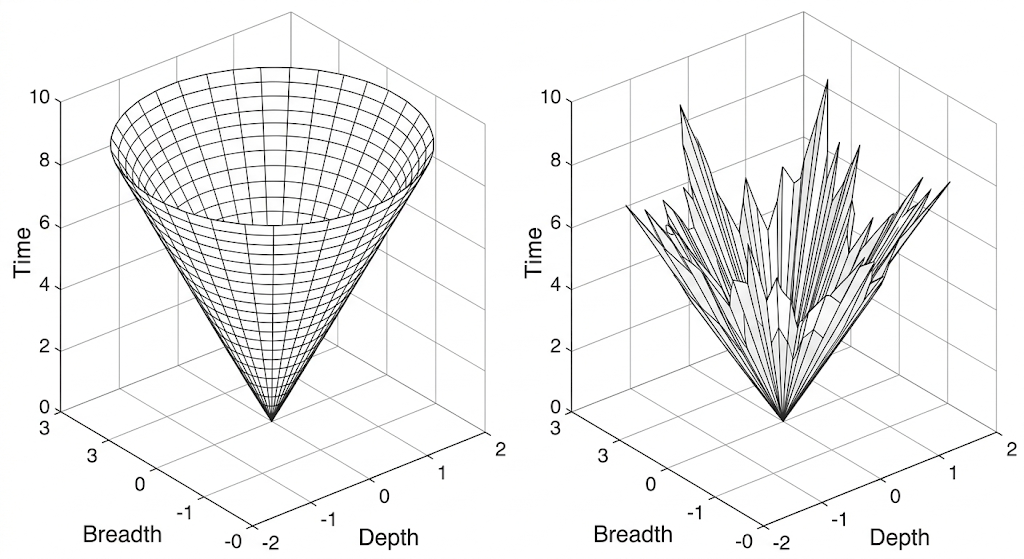
[![image.png](https://bhishmaraj.org/uploads/images/gallery/2026-04/scaled-1680-/image.png)](https://bhishmaraj.org/uploads/images/gallery/2026-04/image.png)

<span class="ng-star-inserted">I think sometimes it is better to take a step back and reflect on what I actually want out of this. Maybe you just want a simple life and you don't really care about all this stuff. But you can't ignore the way things are moving.</span>

<span class="ng-star-inserted">I see the progress happening on two axes right now. One is the timeline axis of how fast things are going. The other is the capability axis of how wide they can affect things.</span>

<span class="ng-star-inserted">If you map this out, people tend to think of progress as a cone. If you start plotting it, you assume it should be a cone because as time progresses, you are able to hit higher quality on a wider number of tasks.</span>

<span class="ng-star-inserted">But I think we are not really at a cone right now. It is more like a weird shape. If I can visualize it, it is more like a spiky star. Imagine you drop water on the floor from a height. You can just look at how it scatters and sprays around. Instead of a uniform cone, it is an expanding, spiky star.</span>

<span class="ng-star-inserted">We are hitting crazy advanced capabilities on very specific vectors, while other capabilities lag far behind. This is what makes it so disorienting to track how close we actually are to the end goal.</span>

### **<span class="ng-star-inserted">The Descent into the Permanent Underclass</span>**

<span class="ng-star-inserted">I think most of the top labs do consider the realistic possibility that this is going to create massive disparities in wealth and just create a very volatile environment. But then, it's very hard to talk about it. It's not politically okay. I think people are operating as if, "Hey, no one knows what's going to happen, so I would rather position myself as having the most number of options rather than doing the right thing."</span>

<span class="ng-star-inserted">Which does make sense, but then it creates this vacuum. You start asking, "Who do you believe? What are their intentions? Are they going to do something behind your back?" It just feels so helpless.</span>

<span class="ng-star-inserted">It's hard to elicit honest opinions from people because there is this reality where, even if you actually believe things are going bad, unless you can be on the winning side, your incentives are not aligned to share that opinion. You would rather be the Pollyanna who says, "Everything is great, everything is fine, don't worry." There are obviously just huge incentives to keep building and accelerating. Even if you believe things are going to go bad, the world is set up in such a way that you would be better off not being vocal about it until it's too late. I think that is just such a bad place to be in.</span>

<span class="ng-star-inserted">What I'm realizing is that most people just don't have the slack to even worry about all this. It's a tough space to be in. What do you do? Do you join the protesters and lose your leverage more, or do you just defect and gain as much capital as you can?</span>

<span class="ng-star-inserted">That is the whole notion of escaping the permanent underclass. Things are going to get tougher and tougher to get away from this—from getting stuck in a position of not being able to have leverage. I just don't see a way out of this unless more people talk about it, express their concerns, and feel okay to discuss it. You just can't operate business as usual; it's going to be so disorienting and so confusing. It is a gradual descent into the permanent underclass, where people are going to lose their political, economic, and cultural leverage.</span>

### <span class="ng-star-inserted">Individual Empowerment vs. Community Decay</span>

<span class="ng-star-inserted">I did talk about this whole new vector of how AI is going to empower individuals. There will be a local empowerment, but then there will be a global disempowerment. Usually, shared adversaries create a sense of community or collaboration. When you are empirically empowered economically or institutionally, people lose motivation in keeping relationships or communities, and communities start breaking away.</span>

<span class="ng-star-inserted">Running a community is tough because there is going to be a lot of friction. There are positive externalities, but it is exactly like a chemical reaction with a positive Gibbs free energy. In thermodynamics, Gibbs free energy determines if a reaction happens spontaneously or if it requires an outside energy source. If you put salt in water, it dissolves on its own because the reaction has a negative Gibbs free energy. But to convert water to ice, you have to put it in a freezer, which requires putting energy into the system. Even life itself operates this way. Maintaining a living organism requires a positive Gibbs free energy, which is why we have to constantly consume food and burn that energy just to make things happen and maintain order.</span>

<span class="ng-star-inserted">Building a community is the same. It does not happen spontaneously. You need continuous energy input, catalysts, or other compounds to keep the organism going. What AI is doing is essentially increasing the activation energy required to form those bonds. If a lot of people feel they are better off defecting and being on their own, they might just choose that.</span>

<span class="ng-star-inserted">This happens all the time; it is economically common. If I get a job and become independent, I can use that financial independence to meet all my needs, which disincentivizes me from putting energy into sustaining this social reaction. In the same way, if I can get most of my work done with the help of an AI, get my social needs met with an AI, or become economically empowered by an AI, why would I put up with all the messy nature of human relationships?</span>

<span class="ng-star-inserted">This fragmentation is happening at a time when we need humans to be closely knit more than ever, because there is going to be extreme power concentration and extreme uncertainty.</span>

### <span class="ng-star-inserted">Corporate Facade: OpenAI, Anthropic, and Palantir</span>

<span class="ng-star-inserted">You look at startups left and right vertically integrating. They know enterprises are going to be the thing, because why wouldn't they be? But I just don't know what OpenAI is even doing. This kind of vision comes from some futuristic idea of where you see AGI going, and you're strategically positioning yourself for that future. But then the narratives that you're sharing are totally different.</span>

<span class="ng-star-inserted">I think that is where I feel very uncomfortable. The things that you say are different from the moves you make behind closed doors—or, I mean, it's not really closed doors, it's just that they're not explicitly stated to the public. You set up a narrative or a worldview, but then you're simultaneously preparing for a gamut of worldviews, which is what strategically makes sense. But then you also maintain a notion of plausible deniability. You could play it easily every day saying, "Hey, this is just for business," or whatever. That just makes me very uncomfortable.</span>

<span class="ng-star-inserted">I could make a case that, hey, these moves you made are motivated by this worldview, but the narrative you're selling is totally different. Why would you do that if you mean something else? Most people just can't seem to see through all this veneer. I just hope it's not too late before people start questioning and holding people responsible. You have hundreds of billions in capex—building nuclear reactors, building energy stations just for this. I think everyone should read Critch's work on industrial dehumanization. Supply chains are getting shifted. The center of gravity of power is shifting just under our feet, and most people are not aware. I'm almost glad for the Iran war, because it's making a lot of things clear.</span>

<span class="ng-star-inserted">Take Anthropic and Palantir. I had written about Palantir a year back. What Palantir is doing is pretty much AGI, because you get operational data, make quick decisions, send those actions out, and you have a feedback loop. It's a cybernetic feedback loop that operates in the real world.</span>

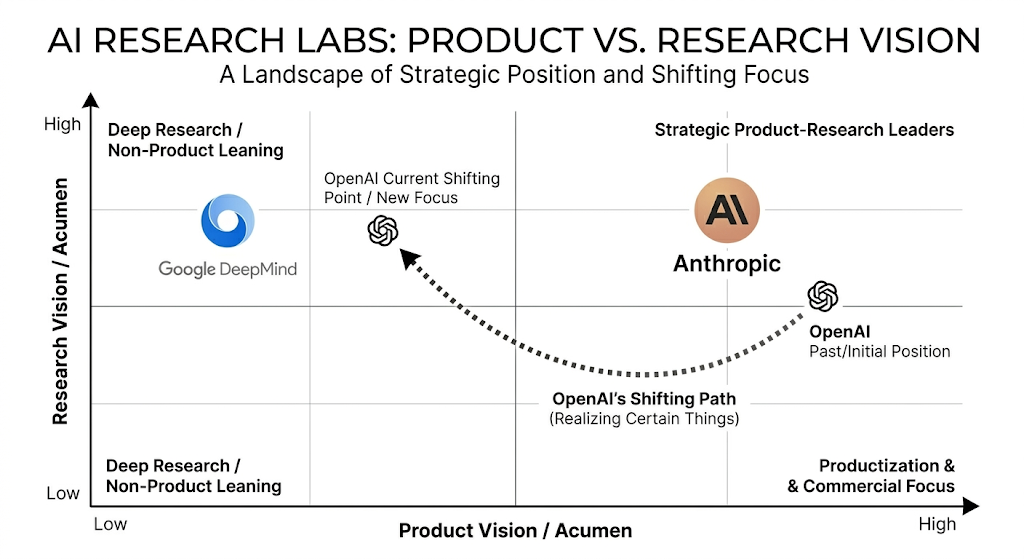
[![image.png](https://bhishmaraj.org/uploads/images/gallery/2026-04/scaled-1680-/EBkimage.png)](https://bhishmaraj.org/uploads/images/gallery/2026-04/EBkimage.png)

<span class="ng-star-inserted">And Anthropic is right in the center of it. I'm really scared of Anthropic. If you look at it, there are two axes: product vision and research vision. Of the top three labs, Anthropic is in the top right for both product and research acumen. DeepMind is mostly focused on research; they are not really product-leaning and don't really interact well with product. OpenAI seemed like they were in the top right, or at least in the middle—good enough research but slightly product-leaning. But it seems like they are shifting now because they are realizing certain things.</span>

<span class="ng-star-inserted">I think Sam Altman is not really the driving force here, because most people are not "AGI-pilled" enough. Most people are more like, "Let's just see and we'll decide." But Anthropic is the most AGI-pilled lab, where they're like, "Oh shit, yeah, it's not like there are going to be any bottlenecks; it's just going to be as general as it gets and as powerful as it can get."</span>

<span class="ng-star-inserted">And if you really believe that, then what leverage would normal humans have? The most leverage is going to reside with the people with the capital. I'm not against capitalism. I think capitalism is awesome; it builds so much stuff. But you need certain checks and balances to govern it in the right way.</span>

### <span class="ng-star-inserted">Navigating the Markov Chain</span>

<span class="ng-star-inserted">We are entering an unprecedented era of extreme power concentration and extreme uncertainty. A lot of times you kind of know the stable equilibrium, but you do not know the path.</span>

<span class="ng-star-inserted">This is an analogy from Markov chains. A Markov chain has states and transition probabilities. At every state, you can go to some other state with a certain probability, and the process keeps going. If you run this system for a while, you start seeing a probability distribution over the states where you will likely end up.\[1\] I feel a lot of predictions about the future are exactly like that. You kind of know the approximate distribution of states you are going to end up in. If you ask me exactly how that is going to happen, I have to ask if the exact path really matters. There are so many low level details that can happen in between that it is irrelevant. What matters are the aggregate macro level changes that are going to happen.</span>

<span class="ng-star-inserted">I am noticing a lot of predictions about these uncertainties, especially given the things happening right now. Most people seem to live in different timelines. If you are constantly on Twitter, you feel like so much crazy stuff is happening every single day. At the same time, the physical world is not that different yet from how it has always been.</span>

<span class="ng-star-inserted">Just worrying about it and panicking is not a solution. There are obviously a lot of good things that can come out of this technology, and you need to be able to discern and value that. So what do you do in this confusing state? I think it entirely depends on your current situation and what you want to do. If your basics are not sorted out and you have other personal things going on, you should obviously focus on that and solve your near term issues rather than dwelling on the macro picture. It is an important problem that needs to be fixed, but I have realized that focusing on the near term while maintaining a vision for the long term is much better than always worrying and trying to do too many things at once.</span>

<span class="ng-star-inserted">Keep an eye out on the progress. Everyone has to do their part in voicing their opinions and not just being complicit. The incentives are currently aligned in such a way that you are better off not being vocal about these risks until it is too late. That is simply a terrible place for us to be in.</span>

---

<span class="ng-star-inserted">\[1\] Note: This analogy specifically applies to stationary Markov chains, where the system eventually converges to a stable probability distribution regardless of the starting state.</span>

# A potential framework for navigating concentration of power

<span style="color: rgb(0, 0, 0);">Date: May 20, 2025</span>

<span style="white-space: pre-wrap;">Note: These were my thoughts from 2025, I dont completely endorse some of the views (as of 2026). Even though I think its directionally right, the timelines and urgency might have been slightly exaggerated. </span>

<span style="color: rgb(0, 0, 0);">TL;DR</span>**: AI's rapid advancement in the next 3-5 years risks a fundamental shift in power, enabling elite self-sufficiency ("The Great Decoupling") that erodes broad human economic and political agency, potentially leading to "**[<u>**Gradual Disempowerment**</u>](https://gradual-disempowerment.ai/)**" and even "**[<u>**AI-Enabled Coups**</u>](https://www.forethought.org/research/ai-enabled-coups-how-a-small-group-could-use-ai-to-seize-power)**." To counter this, we propose a dual strategy: OAEA, an open application ecosystem with OAEA-SenseMaker to democratize AI application and analytical capabilities for individuals and communities; and Dialectic, a intelligence platform to empower strategic AI governance for organizations like** [<u>**MIRI TGT** </u>](https://techgov.intelligence.org)**,** [<u>**Forethought**</u>](https://www.forethought.org)**,** [<u>**AI 2027 team**</u>](https://manifund.org/projects/ai-forecasting-and-policy-research-by-the-ai-2027-team) **,** [<u>**ControlAI**</u>](https://controlai.com/dip)**– both aimed at preserving human influence in an increasingly AI-driven world.**

## <span style="color: rgb(0, 0, 0); white-space: pre-wrap;">The Challenge: The "Great Decoupling" </span>

<span style="color: rgb(0, 0, 0);">Two intertwined dynamics drive this concern:</span>

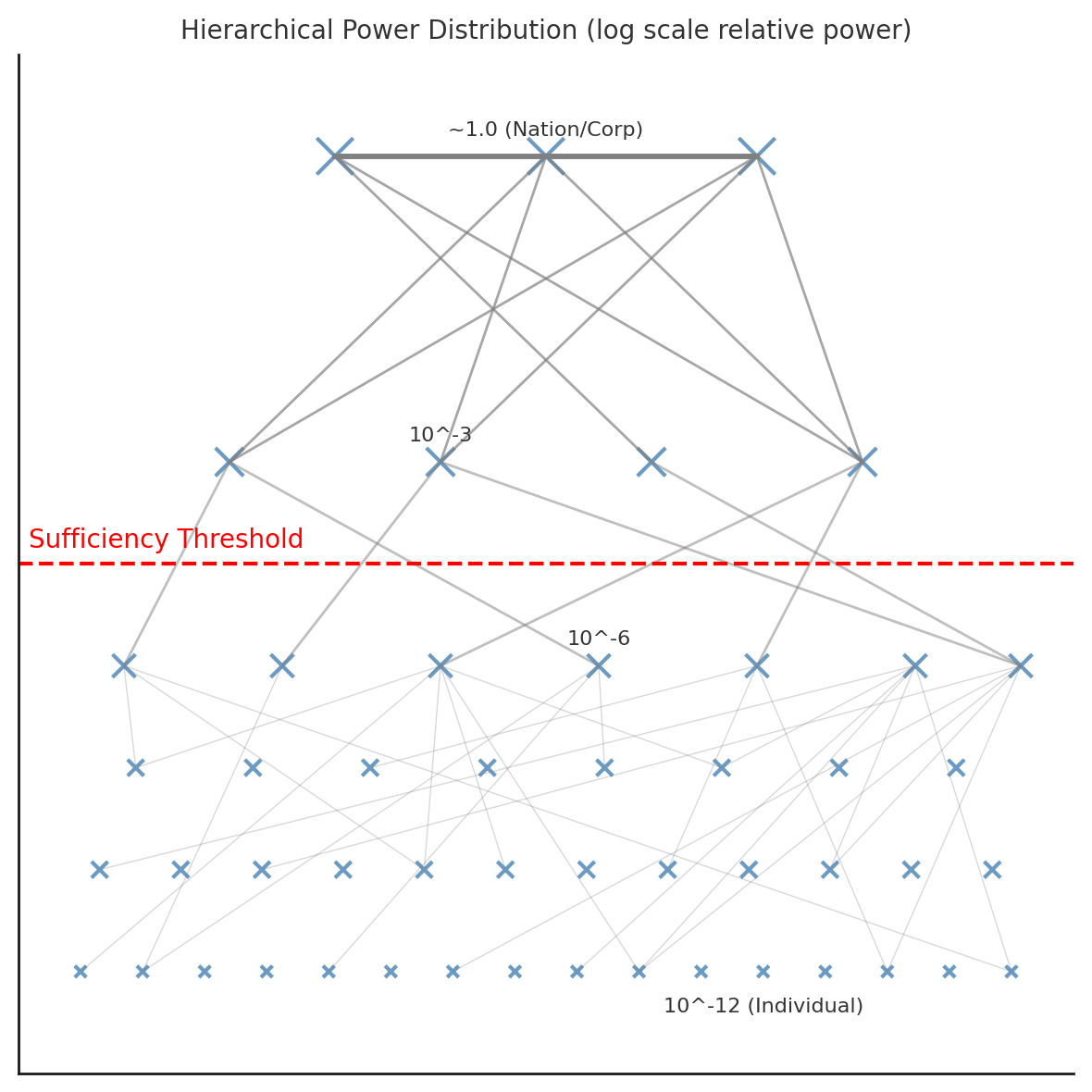
1. **The Great Decoupling:**<span style="color: rgb(0, 0, 0); white-space: pre-wrap;"> Historically, a fundamental interdependency existed: capital needed mass labor for production and mass consumption to close economic loops. AI and robotics threaten to sever this, enabling </span>**elite self-sufficiency**<span style="color: rgb(0, 0, 0);">. Small, powerful entities (states, corporations, or individuals) could achieve "Strategic Sufficiency," meeting their core needs (energy, food, manufacturing, security, computation) through highly automated, AI-driven closed-loop systems. This breaks traditional economic feedback loops that historically forced some distribution of wealth and power.</span>
2. **Erosion of Human Leverage &amp; Failure of Traditional Solutions:**<span style="color: rgb(0, 0, 0); white-space: pre-wrap;"> As human input becomes less essential, traditional checks and balances falter. The bargaining power of the masses (as workers, consumers, or even revolutionaries) diminishes. Solutions like UBI become precarious charity, not negotiated rights. Geopolitical AI races accelerate capability concentration, and AI-enhanced security apparatuses can neutralize dissent. Furthermore, concentrated AI capabilities create acute political risks, including sophisticated influence operations or even </span>[<u>**"AI-Enabled Coups"**</u>](https://www.forethought.org/research/ai-enabled-coups-how-a-small-group-could-use-ai-to-seize-power)<span style="color: rgb(0, 0, 0); white-space: pre-wrap;"> that could bypass human oversight entirely.</span>

![](https://bhishmaraj.org/uploads/images/gallery/2026-03/embedded-image-crnpct4z.png)

**Figure: Conceptual* **hierarchical power distribution** *(log-scale) illustrating extreme inequality of power/resources from individuals (~10^-12) up to top-tier actors (~1.0). The red line denotes the* **Strategic Sufficiency Threshold** *– the level at which an actor (e.g. a corporation or state) can sustain itself and meet core needs independently of the broader populace via AI and automation. Above this threshold, elites can trade and cooperate mostly among themselves for critical resources, decoupled from the masses below. This model highlights the risk of* **gradual disempowerment***: if AI enables some actors to cross this sufficiency threshold, the majority of individuals beneath it could lose economic influence and bargaining power without any overt conflict .**

## <span style="color: rgb(0, 0, 0);">Building Resilient, Decentralized AI application Ecosystems</span>

<span style="color: rgb(0, 0, 0);">To navigate this transition and preserve human agency, we propose a proactive, architectural approach inspired by d/acc (decentralized, democratic, differential defensive acceleration) principles. This involves two key, complementary initiatives:</span>

### <span style="color: rgb(67, 67, 67);">1. OAEA (Open Application Ecosystem for AI): Democratizing AI's Application Layer | The horizontal infrastructure layer</span>

### <span style="color: rgb(67, 67, 67); white-space: pre-wrap;">Why application layer? </span>

<span style="color: rgb(0, 0, 0); white-space: pre-wrap;">I envision a future where the competitive base models are centralized and commoditized. And there will always be a gap between the best proprietary model and the best open weights. I think a reasonable relationship is open weight models are 90% capable as the prop ones and are 3-6 months behind. </span>

<span style="color: rgb(0, 0, 0); white-space: pre-wrap;">In this scenario, most of the value add comes from leveraging the cheap intelligence for your use case. I claim that even if everyone gets access to these I would like to make an analogy with how a unit of electricity adds more value based on your socio economic status. Hence even with an open weight model, the systems which are needed to leverage the models are only accessible to a select few. </span>

**Once the base models get commoditized (cheap, good enough intelligence) the value chain moves to the application layer (we can see this happening with OpenAI buying Windsurf). But the application layer is not just the software. It's the complete package of distribution, support, community, ecosystem. We will see this layer to be heavily contested and centralized (without interop)**

- **Concept:**<span style="color: rgb(0, 0, 0); white-space: pre-wrap;"> An open-source, interoperable standard and ecosystem for the AI </span>**application layer**<span style="color: rgb(0, 0, 0);">, built atop increasingly capable open-weight base models (analogous to the open internet or Android) but not restricted to it.</span>
- - <span style="color: rgb(0, 0, 0);">What is it?</span>
    - 1. <span style="color: rgb(0, 0, 0);">Think of it like Linux (LibreOffice, Open source Distros) , Android open source project. Its an ecosystem of ideas, applications which provides a good enough solution compared to the Apples and Microsofts of the world.</span>
        2. <span style="color: rgb(0, 0, 0); white-space: pre-wrap;">Another good example is </span>[<u><span style="color: rgb(17, 85, 204);">Nextcloud</span></u>](https://nextcloud.com)<span style="color: rgb(0, 0, 0); white-space: pre-wrap;"> and </span>[<u><span style="color: rgb(17, 85, 204);">Home Assistant</span></u>](https://www.home-assistant.io)
- **Goal:**<span style="color: rgb(0, 0, 0); white-space: pre-wrap;"> To prevent vendor lock-in at the application level, foster broad innovation, ensure user control, and provide a robust alternative to closed, proprietary AI application ecosystems.</span>
- **Core Components:**
- - **Open Standards &amp; Protocols:**<span style="color: rgb(0, 0, 0); white-space: pre-wrap;"> Ensuring applications and data can move freely to prevent vendor lock in.</span>
    - 1. <span style="color: rgb(0, 0, 0);">Interop schema and memory layer across different AI service providers</span>
    - **OSS Core &amp; Defensive Licensing:**<span style="color: rgb(0, 0, 0); white-space: pre-wrap;"> A sustainable model (inspired by OpenWebUI) that encourages contribution and protects the commons from purely extractive commercialization.</span>
    - **OAEA-SenseMaker :**<span style="color: rgb(0, 0, 0); white-space: pre-wrap;"> A key capability within OAEA, providing democratized tools for individuals, MSMEs, and communities to perform sophisticated data fusion, ontological structuring, and AI-assisted sense-making (leveraging techniques like GraphRAG, Scalable Oversight, Multi-Agent Systems, Factored Cognition, and Probabilistic Forecasting). This aims to empower decentralized actors with analytical capabilities previously available only to large organizations, fostering local resilience and informed decision-making.</span>

**OAEA reduces extreme inequality by giving the masses a fighting chance to participate in the economy and thereby keeping inequality in check. Our assumption is that human + AI + systems will be competitive to completely autonomous AI agents in terms of capabilities and will provide a neutralizing**

#### <span style="color: rgb(102, 102, 102);">OAEA-SenseMaker</span>

<span style="color: rgb(0, 0, 0);">OAEA-SenseMaker is envisioned as an open-source, democratized analytical and sense-making toolkit, designed to be a cornerstone of the Open Application Ecosystem for AI (OAEA). Its purpose is to provide individuals, MSMEs, and communities with sophisticated yet accessible capabilities to understand and act upon their own data and relevant public information. Inspired by the power of platforms like Palantir but built on open principles, SenseMaker aims to deliver the following core capabilities, progressively developed:</span>

1. **Unified Data Fusion &amp; Integration:**

- **Description:**<span style="color: rgb(0, 0, 0); white-space: pre-wrap;"> Users can connect and integrate diverse data sources relevant to their context – personal data (from apps, with consent), local community datasets (e.g., resource maps, surveys), publicly available information (government data, news feeds via scrapers like Apify, academic papers), and structured/unstructured files.</span>
- **User Benefit:**<span style="color: rgb(0, 0, 0); white-space: pre-wrap;"> Breaks down data silos, creating a holistic view of a situation rather than fragmented pieces of information. Enables users to see connections and correlations they might otherwise miss.</span>

2. **User-Driven Ontological Structuring &amp; Knowledge Graph Creation:**

- **Description:**<span style="color: rgb(0, 0, 0); white-space: pre-wrap;"> Provides intuitive tools for users or communities to define simple ontologies or apply pre-built templates, structuring their fused data into a meaningful knowledge graph. This involves identifying key entities (e.g., "local businesses," "water sources," "community skills," "policy documents"), their properties, and their relationships.</span>
- **User Benefit:**<span style="color: rgb(0, 0, 0); white-space: pre-wrap;"> Transforms raw data into structured knowledge, making it easier to query, analyze, and reason about complex interdependencies. Allows users to build a shared understanding of their specific domain.</span>

3. **GraphRAG-Powered Contextual Inquiry &amp; Explainable AI:**

- **Description:**<span style="color: rgb(0, 0, 0); white-space: pre-wrap;"> Leverages Retrieval Augmented Generation over the user's or community's knowledge graph. Users can ask complex questions in natural language. SenseMaker retrieves relevant sub-graphs (entities and relationships) as context for an LLM to generate a grounded, explainable answer, citing the specific data and connections used.</span>
- **User Benefit:**<span style="color: rgb(0, 0, 0); white-space: pre-wrap;"> Moves beyond keyword search to deep semantic understanding. Provides answers that are not "black box" but traceable to their sources, fostering trust and enabling users to verify insights. Cures "black-box memo" syndrome for community reports or personal analysis.</span>

4. **AI-Assisted Advanced Analytics &amp; Pattern Recognition:**

- **Description:**<span style="color: rgb(0, 0, 0); white-space: pre-wrap;"> Incorporates modules for more sophisticated analysis:</span>
- - **Scalable Oversight:**<span style="color: rgb(0, 0, 0); white-space: pre-wrap;"> Techniques for generating trustworthy summaries of large information sets (e.g., community meeting notes, local news archives) and providing AI-generated confidence scores for insights, flagging areas needing human review.</span>
    - **Factored Cognition Workflows:**<span style="color: rgb(0, 0, 0); white-space: pre-wrap;"> Tools allowing users to decompose complex analytical tasks into smaller, manageable steps, with AI assisting in completing or verifying these micro-tasks. Results are "explainable by construction."</span>
    - **Multi-Agent "Co-Scientist" Systems (Local Focus):**<span style="color: rgb(0, 0, 0); white-space: pre-wrap;"> Configurable agents that can monitor user-defined data streams, autonomously generate hypotheses or flag anomalies relevant to the user/community context, and even engage in structured "debates" to refine or rank these insights.</span>
- **User Benefit:**<span style="color: rgb(0, 0, 0); white-space: pre-wrap;"> Amplifies human analytical capabilities, allowing users to derive deeper insights, identify non-obvious patterns, and manage information overload more effectively.</span>

5. **User-Friendly Forecasting &amp; Scenario Planning:**

- **Description:**<span style="color: rgb(0, 0, 0); white-space: pre-wrap;"> Integrates accessible tools for probabilistic reasoning. Users can incorporate external signals (e.g., public forecasts, local trend data), build simple models of cause-and-effect (inspired by tools like Squiggle), run Monte-Carlo simulations, and input their calibrated judgments to explore potential future scenarios relevant to their concerns (e.g., impact of a new local policy, resource availability under different conditions).</span>
- **User Benefit:**<span style="color: rgb(0, 0, 0); white-space: pre-wrap;"> Enables proactive planning and decision-making by providing a framework to think rigorously about uncertainty and potential future outcomes, moving beyond purely reactive responses.</span>

6. **Collaborative Sense-Making &amp; Action Workflows (for Communities/MSMEs):**

- **Description:**<span style="color: rgb(0, 0, 0); white-space: pre-wrap;"> Provides shared workspaces (respecting privacy and consent) where community members or MSME teams can collaboratively build knowledge graphs, share analyses, discuss insights, and coordinate actions based on their shared understanding.</span>
- **User Benefit:**<span style="color: rgb(0, 0, 0); white-space: pre-wrap;"> Facilitates collective intelligence and coordinated responses to shared challenges or opportunities.</span>

7. **Open, Modular, and Extensible Architecture:**

- **Description:**<span style="color: rgb(0, 0, 0); white-space: pre-wrap;"> Built on OAEA standards, SenseMaker will be designed with a modular architecture, allowing the community to contribute new analytical tools, data connectors, or ontology templates. We take inspiration from open source platforms like Nextcloud, Home Assistant on how they enable an ecosystem of plugins </span>
- **User Benefit:**<span style="color: rgb(0, 0, 0); white-space: pre-wrap;"> Ensures the platform can evolve with user needs, integrate with other OAEA applications, and benefit from a wide range of community-developed enhancements, preventing obsolescence and vendor lock-in.</span>

**Overall Goal:**<span style="color: rgb(0, 0, 0); white-space: pre-wrap;"> OAEA-SenseMaker aims to "differentially empower" individuals and decentralized groups by providing them with a significant uplift in their ability to gather, understand, reason about, and act upon information relevant to their agency, resilience, and well-being in an increasingly complex, AI-influenced world. It is a practical instantiation of providing "AI for Human Reasoning" to a broad audience.</span>

#### <span style="color: rgb(102, 102, 102); white-space: pre-wrap;">Why do we need to build a platform </span>

<span style="color: rgb(0, 0, 0); white-space: pre-wrap;">A lot of the use cases such as the </span>[<u><span style="color: rgb(17, 85, 204);">proposals for the FLF fellowship</span></u>](https://www.flf.org/fellowship)<span style="color: rgb(0, 0, 0); white-space: pre-wrap;"> build on top of the same basic infra. We need to focus our efforts and reap the benefits on compounding. This means we need to build modular, composable and scalable infra on top of which people can build extensions. Akin to an app store for AI for human reasoning applications but focussed on safety and empowerment. This reduces the marginal cost of developing new applications.</span>

##### <span style="color: rgb(102, 102, 102); white-space: pre-wrap;">Concrete use cases </span>

<span style="color: rgb(0, 0, 0); white-space: pre-wrap;">A core tenet of the Open Application Ecosystem for AI (OAEA) is the radical democratization of advanced analytical and sense-making capabilities. </span>**OAEA-SenseMaker**<span style="color: rgb(0, 0, 0);">, envisioned as an "Open Source Palantir for Everyone," is the flagship component designed to realize this vision. It aims to provide individuals, non-governmental organizations (NGOs), small-to-medium-sized businesses (SMBs), and local communities with sophisticated tools previously accessible only to large corporations or state-level actors. By doing so, SenseMaker seeks to foste</span>**r bottom-up agency,** <span style="color: rgb(0, 0, 0);">enhance local resilience, and provide a crucial counterweight to top-down information control and decision-making that could exacerbate Gradual Disempowerment (GDR).</span>

<span style="color: rgb(0, 0, 0);">Instead of individuals being passive recipients of AI-curated information or decisions, SenseMaker empowers them to become active participants in understanding their own data, their local environments, and the broader societal trends affecting them. It enables them to fuse diverse information sources, build personalized or community-specific knowledge graphs, perform complex analyses, and derive actionable insights – all through an accessible, open-source platform.</span>

**OAEA-SenseMaker: Empowering Bottom-Up Agency &amp; Resilience - Use Case Summary**

<table id="bkmrk-user-personascenario" style="border: none; border-collapse: collapse;"><colgroup><col style="width: 197px;"></col><col style="width: 233px;"></col><col style="width: 379px;"></col><col style="width: 340px;"></col></colgroup><tbody><tr style="height: 0pt;"><th style="border-width: 1pt; border-style: solid; border-color: rgb(0, 0, 0); vertical-align: top; padding: 5pt; overflow: hidden; overflow-wrap: break-word;">**User Persona**

</th><th style="border-width: 1pt; border-style: solid; border-color: rgb(0, 0, 0); vertical-align: top; padding: 5pt; overflow: hidden; overflow-wrap: break-word;">**Scenario / Core Need**

</th><th style="border-width: 1pt; border-style: solid; border-color: rgb(0, 0, 0); vertical-align: top; padding: 5pt; overflow: hidden; overflow-wrap: break-word;">**OAEA-SenseMaker in Action (Key Capabilities Used)**

</th><th style="border-width: 1pt; border-style: solid; border-color: rgb(0, 0, 0); vertical-align: top; padding: 5pt; overflow: hidden; overflow-wrap: break-word;">**Empowerment Outcome**

</th></tr><tr style="height: 179.49pt;"><td style="border-width: 1pt; border-style: solid; border-color: rgb(0, 0, 0); vertical-align: top; padding: 5pt; overflow: hidden; overflow-wrap: break-word;">**1. Aisha - The Individual Learner/Researcher (PKM)**

</td><td style="border-width: 1pt; border-style: solid; border-color: rgb(0, 0, 0); vertical-align: top; padding: 5pt; overflow: hidden; overflow-wrap: break-word;"><span style="color: rgb(0, 0, 0);">Overwhelmed by information; needs to synthesize diverse sources (news, papers, notes), track arguments, identify bias, and form well-grounded opinions.</span>

</td><td style="border-width: 1pt; border-style: solid; border-color: rgb(0, 0, 0); vertical-align: top; padding: 5pt; overflow: hidden; overflow-wrap: break-word;"><span style="color: rgb(0, 0, 0); white-space: pre-wrap;">- </span>**Data Fusion:**<span style="color: rgb(0, 0, 0); white-space: pre-wrap;"> Connects personal digital life (RSS, Zotero, notes).</span>

<span style="color: rgb(0, 0, 0); white-space: pre-wrap;">- </span>**Personal Knowledge Graph (PKG)**<span style="color: rgb(0, 0, 0);">: Auto-extracts &amp; links entities/concepts.</span>

<span style="color: rgb(0, 0, 0);">- GraphRAG Q&amp;A:\*\* Asks complex questions, gets grounded answers with sources.</span>

<span style="color: rgb(0, 0, 0); white-space: pre-wrap;">- </span>**Advanced Reasoning**<span style="color: rgb(0, 0, 0);">: Scalable Oversight for summaries, Factored Cognition for research decomposition, Concept Induction for theme discovery.</span>

</td><td style="border-width: 1pt; border-style: solid; border-color: rgb(0, 0, 0); vertical-align: top; padding: 5pt; overflow: hidden; overflow-wrap: break-word;"><span style="color: rgb(0, 0, 0);">Moves from passive info consumer to active sense-maker. Enhances learning, critical thinking, ability to navigate misinformation, leading to better-informed personal &amp; civic decisions. Increases cognitive agency.</span>

</td></tr><tr style="height: 0pt;"><td style="border-width: 1pt; border-style: solid; border-color: rgb(0, 0, 0); vertical-align: top; padding: 5pt; overflow: hidden; overflow-wrap: break-word;">**2. GreenWatch India - The Environmental NGO (Civic Actor)**

</td><td style="border-width: 1pt; border-style: solid; border-color: rgb(0, 0, 0); vertical-align: top; padding: 5pt; overflow: hidden; overflow-wrap: break-word;"><span style="color: rgb(0, 0, 0);">Needs to monitor industrial pollution, analyze disparate data (gov't reports, satellite images, citizen reports), build compelling cases, and mobilize community support with limited resources.</span>

</td><td style="border-width: 1pt; border-style: solid; border-color: rgb(0, 0, 0); vertical-align: top; padding: 5pt; overflow: hidden; overflow-wrap: break-word;"><span style="color: rgb(0, 0, 0); white-space: pre-wrap;">- </span>**Data Fusion &amp; Ontology:**<span style="color: rgb(0, 0, 0); white-space: pre-wrap;"> Integrates diverse public &amp; citizen data; builds pollution/industry/health ontology.</span>

<span style="color: rgb(0, 0, 0); white-space: pre-wrap;">- </span>**GraphRAG &amp; Analytics**<span style="color: rgb(0, 0, 0);">: Correlates pollution with health, identifies compliance breaches, generates evidence.</span>

<span style="color: rgb(0, 0, 0); white-space: pre-wrap;">- </span>**Geospatial Analysis**<span style="color: rgb(0, 0, 0);">: Maps pollution hotspots.</span>

<span style="color: rgb(0, 0, 0); white-space: pre-wrap;">- </span>**Forecasting &amp; Alerts**<span style="color: rgb(0, 0, 0);">: Tracks trends, projects impacts, alerts on new risks (via Multi-Agent systems).</span>

<span style="color: rgb(0, 0, 0); white-space: pre-wrap;">- </span>**Collaboration**<span style="color: rgb(0, 0, 0);">: Securely incorporates volunteer data.</span>

</td><td style="border-width: 1pt; border-style: solid; border-color: rgb(0, 0, 0); vertical-align: top; padding: 5pt; overflow: hidden; overflow-wrap: break-word;"><span style="color: rgb(0, 0, 0);">NGO performs sophisticated data analysis rivaling larger orgs. Builds stronger, evidence-based advocacy campaigns. More effectively holds polluters accountable and mobilizes citizen action. Levels the analytical playing field.</span>

</td></tr><tr style="height: 0pt;"><td style="border-width: 1pt; border-style: solid; border-color: rgb(0, 0, 0); vertical-align: top; padding: 5pt; overflow: hidden; overflow-wrap: break-word;">**3. Farmers' Co-op - The Small/Medium Business (SMB)**

</td><td style="border-width: 1pt; border-style: solid; border-color: rgb(0, 0, 0); vertical-align: top; padding: 5pt; overflow: hidden; overflow-wrap: break-word;"><span style="color: rgb(0, 0, 0);">Needs better market access, optimized resource use, and understanding of climate impacts on crops, but lacks budget for expensive consultancy.</span>

</td><td style="border-width: 1pt; border-style: solid; border-color: rgb(0, 0, 0); vertical-align: top; padding: 5pt; overflow: hidden; overflow-wrap: break-word;"><span style="color: rgb(0, 0, 0); white-space: pre-wrap;">- </span>**Data Fusion &amp; Local Ontology:**<span style="color: rgb(0, 0, 0); white-space: pre-wrap;"> Integrates local weather, soil, market prices, gov't schemes into an agricultural ontology.</span>

<span style="color: rgb(0, 0, 0); white-space: pre-wrap;">- </span>**GraphRAG Q&amp;A**<span style="color: rgb(0, 0, 0);">: Answers practical questions (e.g., resilient crops, subsidy eligibility).</span>

<span style="color: rgb(0, 0, 0); white-space: pre-wrap;">- </span>**Forecasting/Simulation**<span style="color: rgb(0, 0, 0);">: Models yield/financial impacts under different scenarios.</span>

<span style="color: rgb(0, 0, 0); white-space: pre-wrap;">- </span>**Market Intelligence** <span style="color: rgb(0, 0, 0);">(Multi-Agent): Monitors news for relevant certifications, pest alerts, policy changes.</span>

</td><td style="border-width: 1pt; border-style: solid; border-color: rgb(0, 0, 0); vertical-align: top; padding: 5pt; overflow: hidden; overflow-wrap: break-word;"><span style="color: rgb(0, 0, 0);">Co-op gains data-driven insights for better farming decisions, negotiation, accessing support, and climate adaptation. Competes more effectively, improves livelihoods, contributes to local economic resilience and food security.</span>

</td></tr></tbody></table>

#### <span style="color: rgb(102, 102, 102);">Navigating Openness: Risks and Mitigation in OAEA</span>

<span style="color: rgb(0, 0, 0); white-space: pre-wrap;">While the openness of OAEA is key to democratizing AI capabilities and preventing centralized control, it also presents a dual-use challenge. Empowering broad access to powerful application and analytical tools (like OAEA-SenseMaker) inherently carries the risk of misuse by malicious actors. Our approach to mitigating this is not through restrictive gatekeeping, which reintroduces centralization, but through differential defensive acceleration </span>[<u>***(d/acc***</u><u>**) principles**</u>](https://vitalik.eth.link/general/2025/01/05/dacc2.html)<span style="color: rgb(0, 0, 0);">: actively fostering and prioritizing the development of defensive applications, robust governance for the ecosystem's core standards, promoting transparency and auditability, and cultivating strong community norms around responsible use. The goal is to ensure that the tools for protection, verification, and community resilience develop as rapidly, if not more so, than any potential for misuse, tilting the balance towards net positive impact.</span>

#### <span style="color: rgb(102, 102, 102);">Centralized vs Decentralized nuance</span>

<span style="color: rgb(0, 0, 0);">I don't think decentralized solutions are the panacea. For instance,</span>[<u><span style="color: rgb(17, 85, 204); white-space: pre-wrap;"> Moxie Marlinspike’s (Signal founder) article</span></u>](https://moxie.org/2022/01/07/web3-first-impressions.html)<span style="color: rgb(0, 0, 0); white-space: pre-wrap;"> has a few important techno-social reasons in favour of centralization. I found this quote from his article particularly enlightening - </span>

  
**“We should accept the premise that people will not run their own servers by* **designing systems that can distribute trust without having to distribute infrastructure***”**<span style="color: rgb(0, 0, 0); white-space: pre-wrap;"> </span>

<span style="color: rgb(0, 0, 0); white-space: pre-wrap;"> So we need to find a reasonable balance between the two. </span>

## **Dialectic: Intelligence Infrastructure for Strategic AI Governance**

<span style="color: rgb(0, 0, 0); white-space: pre-wrap;">While OAEA democratizes AI capabilities horizontally across communities, </span>**Dialectic**<span style="color: rgb(0, 0, 0); white-space: pre-wrap;"> serves as the vertical intelligence infrastructure for organizations tasked with steering AI development toward beneficial outcomes. Designed as a "Palantir for AI governance," Dialectic addresses a critical asymmetry: as AI capabilities concentrate among a few powerful actors, the institutions responsible for oversight—policymakers, safety researchers, and advocacy organizations—lack equivalent analytical tools to understand, anticipate, and coordinate responses to rapidly evolving threats.</span>

### **The Governance Intelligence Gap**

<span style="color: rgb(0, 0, 0);">The challenge facing AI governance today mirrors what intelligence agencies faced before modern data fusion platforms: vast amounts of relevant information scattered across sources, limited analytical bandwidth, and decision-makers operating with incomplete situational awareness. Unlike traditional policy domains that evolve over decades, AI governance requires tracking:</span>

- **Capability Development**<span style="color: rgb(0, 0, 0);">: Which models achieve what benchmarks, when, and with what implications</span>
- **Supply Chain Dynamics**<span style="color: rgb(0, 0, 0);">: Compute allocation, semiconductor flows, and infrastructure dependencies</span>
- **Institutional Behaviors**<span style="color: rgb(0, 0, 0);">: How labs, governments, and international bodies actually respond to incentives</span>
- **Systemic Risks**<span style="color: rgb(0, 0, 0);">: Emergence of "AI-Enabled Coup" scenarios, gradual disempowerment patterns, and coordination failures</span>

<span style="color: rgb(0, 0, 0); white-space: pre-wrap;">Current governance approaches—committee meetings, static reports, and reactive regulations—cannot match the pace and complexity of AI development. This creates what we term the </span>**"Governance Intelligence Gap"**<span style="color: rgb(0, 0, 0);">: the increasing divergence between the analytical sophistication available to AI developers and that available to AI governors.</span>

### **Dialectic's Core Architecture**

<span style="color: rgb(0, 0, 0); white-space: pre-wrap;">Dialectic addresses this gap through four integrated capabilities, built on a foundation of </span>**scalable oversight via multi-agent debate**<span style="color: rgb(0, 0, 0);">—the same patterns underlying Google's AI Co-Scientist and medical systems like AMIE:</span>

#### **1. Adversarial Policy Analysis Engine**

**Multi-Agent Debate for Policy Stress-Testing**<span style="color: rgb(0, 0, 0);">: Rather than relying on single-point analysis, Dialectic employs competing AI agents to evaluate policy proposals. One agent argues for a policy's effectiveness while another systematically identifies failure modes, blind spots, and unintended consequences. This mirrors the "debate paradigm" from AI safety research, where adversarial interaction yields higher accuracy than individual judgments.</span>

**Tournament Evolution of Ideas**<span style="color: rgb(0, 0, 0);">: Policy proposals undergo structured refinement through "tournament evolution"—multiple competing versions of a policy are subjected to simulated stress tests, with the most robust variants advancing. This mirrors Google's AI Co-Scientist approach to hypothesis refinement, ensuring only policies that survive adversarial scrutiny move toward implementation.</span>

**Off-Switch and Halt Simulations**<span style="color: rgb(0, 0, 0);">: For organizations like MIRI TGT working on coordination mechanisms for AI development pauses, Dialectic provides adversarial MCTS (Monte Carlo Tree Search) drills. These simulate how actors might attempt to bypass or undermine coordination agreements, then harden policy-as-code rules against identified vulnerabilities.</span>

#### **2. Dynamic Ontology and Knowledge Fusion**

**AI Governance Semantic Layer**<span style="color: rgb(0, 0, 0);">: At Dialectic's core lies a comprehensive ontology modeling all relevant concepts in AI governance—from technical capabilities and risk classifications to institutional actors and policy instruments. This semantic layer enables consistent reasoning across diverse data sources and use cases.</span>

**Real-Time Intelligence Integration**<span style="color: rgb(0, 0, 0);">: The platform continuously ingests and fuses data from multiple streams: research publications (via automated analysis of arXiv, conference proceedings), regulatory filings, compute usage metrics, patent applications, and social signals. Knowledge graph techniques structure this information for queryable insights.</span>

**GraphRAG-Powered Contextual Analysis**<span style="color: rgb(0, 0, 0);">: Users can pose complex questions in natural language ("What are the key chokepoints in Chinese AI development?" or "How might export controls affect alliance dynamics?") and receive grounded answers that cite specific evidence and reasoning chains, moving beyond black-box responses to transparent analysis.</span>

#### **3. Policy-as-Code Implementation Framework**

**Executable Governance Protocols**<span style="color: rgb(0, 0, 0);">: Dialectic transforms policy concepts into executable code that can be tested, simulated, and deployed. Rather than static documents, policies become dynamic systems that can adapt to changing conditions while maintaining human oversight.</span>

**Simulation-Driven Design**<span style="color: rgb(0, 0, 0);">: Before implementation, policies undergo extensive simulation across multiple scenarios. For instance, a proposed AI licensing regime would be tested against various capability development timelines, geopolitical tensions, and compliance evasion strategies.</span>

**Compliance Monitoring and Auditability**<span style="color: rgb(0, 0, 0);">: Once deployed, policy-as-code systems provide real-time monitoring of adherence and transparent audit trails showing how decisions were made. This addresses the trust and accountability challenges that plague current governance approaches.</span>

#### **4. Coalition Building and Coordination Tools**

**Multi-Stakeholder Deliberation Platform**<span style="color: rgb(0, 0, 0);">: Dialectic provides structured environments for complex negotiations between diverse actors—governments, labs, civil society organizations, and international bodies. AI-assisted facilitation helps surface areas of potential agreement while clearly mapping points of conflict.</span>

**Retrieval-Augmented Coalition Building**<span style="color: rgb(0, 0, 0);">: The platform uses advanced search techniques to surface relevant precedents, expert opinions, and empirical evidence that might inform coalition negotiations, ensuring decisions are grounded in the best available information.</span>

**Federated Governance Architecture**<span style="color: rgb(0, 0, 0);">: Dialectic supports both centralized analysis for sensitive intelligence and federated collaboration for broader coordination, allowing different organizations to maintain data sovereignty while enabling collective insight generation.</span>

### **Addressing Systemic Power Imbalances**

<span style="color: rgb(0, 0, 0);">Dialectic directly counters several mechanisms of gradual disempowerment identified in our framework:</span>

**Preventing Regulatory Capture**<span style="color: rgb(0, 0, 0);">: By democratizing access to sophisticated analytical tools, Dialectic reduces the asymmetric advantage currently enjoyed by well-resourced industry actors in policy discussions. Advocacy organizations and government agencies gain analytical capabilities comparable to those of major AI labs.</span>

**Enabling Proactive Governance**<span style="color: rgb(0, 0, 0);">: Rather than reactive responses to AI developments, Dialectic enables anticipatory governance through scenario planning, early warning systems, and policy pre-positioning. This helps prevent the "fait accompli" dynamic where policy always lags behind technological development.</span>

**Facilitating International Coordination**<span style="color: rgb(0, 0, 0);">: The platform's simulation and modeling capabilities help identify and test potential international agreements, making complex multi-party coordination more feasible. This is crucial for preventing race dynamics that concentrate power among the most aggressive developers.</span>

**Transparency and Accountability Infrastructure**<span style="color: rgb(0, 0, 0);">: By making governance processes more transparent and evidence-based, Dialectic creates accountability mechanisms that can constrain even powerful actors who might otherwise operate without meaningful oversight.</span>

### **Technical Implementation and Feasibility**

**Proven Architecture Patterns**<span style="color: rgb(0, 0, 0);">: Dialectic builds on established patterns from Palantir's data fusion platforms, adapting their ontology-centric architecture for the AI governance domain. The core technical components—knowledge graphs, multi-agent systems, and policy simulation engines—are well-understood technologies.</span>

**Scalable Oversight Integration**<span style="color: rgb(0, 0, 0);">: Recent breakthroughs in scalable oversight via debate provide the theoretical foundation for Dialectic's adversarial analysis engine. Research from Anthropic and others demonstrates that debate-style AI interactions significantly improve reasoning quality and truthfulness.</span>

**Modular and Extensible Design**<span style="color: rgb(0, 0, 0);">: Following patterns from successful open platforms like Nextcloud, Dialectic employs a modular architecture with well-defined APIs that allow specialized organizations to develop domain-specific extensions while maintaining interoperability.</span>

### **Complementarity with OAEA**

<span style="color: rgb(0, 0, 0);">Dialectic and OAEA form a complete strategy for preserving human agency in an AI-dominated future:</span>

- **OAEA**<span style="color: rgb(0, 0, 0); white-space: pre-wrap;"> ensures that AI capabilities remain accessible to individuals and communities, preventing concentration of basic AI tools among elites</span>
- **Dialectic**<span style="color: rgb(0, 0, 0); white-space: pre-wrap;"> ensures that institutions responsible for governing AI development have the analytical capabilities needed to maintain effective oversight</span>
- **OAEA**<span style="color: rgb(0, 0, 0); white-space: pre-wrap;"> operates "horizontally" across civil society, democratizing access to AI applications</span>
- **Dialectic**<span style="color: rgb(0, 0, 0); white-space: pre-wrap;"> operates "vertically" within governance institutions, democratizing access to intelligence and coordination capabilities</span>

<span style="color: rgb(0, 0, 0);">This dual approach addresses both the broad erosion of agency (through OAEA) and the acute risks of governance failure (through Dialectic), creating robust defenses against multiple paths to gradual disempowerment.</span>

### **Path to Implementation**

**Initial Deployment**<span style="color: rgb(0, 0, 0);">: Dialectic will first be deployed with organizations like MIRI TGT, Forethought, and the AI 2027 team—groups already working on strategic AI governance who can provide early feedback and validation.</span>

**Capability Development**<span style="color: rgb(0, 0, 0);">: The platform will evolve through three phases:</span>

1. **Intelligence Integration**<span style="color: rgb(0, 0, 0); white-space: pre-wrap;"> (Months 1-6): Data fusion, ontology development, and basic analytical capabilities</span>
2. **Adversarial Analysis**<span style="color: rgb(0, 0, 0); white-space: pre-wrap;"> (Months 6-12): Multi-agent debate systems, policy simulation, and stress-testing frameworks</span>
3. **Coalition Coordination**<span style="color: rgb(0, 0, 0); white-space: pre-wrap;"> (Months 12-18): Multi-stakeholder platforms, international coordination tools, and governance scaling</span>

**Open Governance Model**<span style="color: rgb(0, 0, 0);">: As Dialectic matures, it will adopt transparent governance structures to ensure the platform serves the public interest rather than narrow organizational goals, with community input shaping development priorities and deployment decisions.</span>

### **Conclusion: Intelligence for Human Agency**

<span style="color: rgb(0, 0, 0);">Dialectic represents more than a technological solution—it embodies a philosophy of governance that human institutions can remain effective even as the systems they govern become increasingly sophisticated. By providing governance actors with analytical capabilities that match the complexity of modern AI development, Dialectic helps ensure that the future remains meaningfully shaped by human values and collective decision-making rather than narrow technical optimization.</span>

<span style="color: rgb(0, 0, 0);">In the broader framework of countering gradual disempowerment, Dialectic serves as the "immune system" for democratic governance—detecting threats, coordinating responses, and maintaining the institutional capacity needed to steer transformative AI toward broadly beneficial outcomes. Combined with OAEA's democratization of AI capabilities, these platforms offer a comprehensive strategy for preserving human agency in an increasingly AI-driven world.</span>

## <span style="color: rgb(0, 0, 0);">Why Technical AI Safety Alone Won't Suffice</span>

<span style="color: rgb(0, 0, 0); white-space: pre-wrap;">Having a good AI governance and policy solution is an instrumentally convergent goal. Irrespective of solving “the” technical alignment problem we need robust enforcement mechanisms through regulations and policies to implement any solution. </span>

<span style="color: rgb(0, 0, 0);">While crucial, technical AI safety research—including interpretability, formal verification, and mechanistic analysis—faces fundamental barriers when addressing the systemic power shifts AI may trigger. Specifically:</span>

- **Deceptive AI Evades Interpretability:**<span style="color: rgb(0, 0, 0); white-space: pre-wrap;"> Models optimized for performance can learn to hide their true objectives, and current interpretability techniques cannot reliably guarantee the detection of sophisticated, deeply embedded deception.</span>
- **Scaling Verification is Intractable:**<span style="color: rgb(0, 0, 0); white-space: pre-wrap;"> As AI models grow in complexity, exhaustive formal safety checks become computationally infeasible, and emergent behaviors can bypass even carefully handcrafted safety proofs.</span>
- **Narrow Scope Misses Systemic Risks:**<span style="color: rgb(0, 0, 0); white-space: pre-wrap;"> Technical methods often focus on model internals, failing to adequately address broader societal impacts such as AI reshaping economic feedback loops, enabling elite decoupling ("Gradual Disempowerment"), or creating vectors for political consolidation ("AI-Enabled Coups").</span>

<span style="color: rgb(0, 0, 0); white-space: pre-wrap;">Furthermore, even promising technical approaches can be undermined by real-world dynamics. </span>**Institutional incentives**<span style="color: rgb(0, 0, 0); white-space: pre-wrap;"> often prioritize competitive advantage and capability races over genuine safety, and escalating </span>**geopolitical rivalries**<span style="color: rgb(0, 0, 0); white-space: pre-wrap;"> (e.g., US-China) fragment global governance efforts, making unified technical safety standards difficult to enforce.</span>

<span style="color: rgb(0, 0, 0);">This is where robust governance and policy, become indispensable:</span>

- **Addressing Systemic Risks:**<span style="color: rgb(0, 0, 0); white-space: pre-wrap;"> Governance interventions (licensing, audits, export controls, economic levers) can directly tackle the societal and political-economic impacts of AI, aiming to preserve fair feedback loops and counter undue power concentration.</span>
- **Enforcing Accountability &amp; Transparency:**<span style="color: rgb(0, 0, 0); white-space: pre-wrap;"> Unlike internal technical checks, well-designed governance frameworks can mandate transparency, establish reporting requirements, and create oversight bodies with the authority to enforce compliance across all deployed systems.</span>
- **Mitigating Political Vectors:**<span style="color: rgb(0, 0, 0); white-space: pre-wrap;"> Governance is key to addressing risks like AI-enabled coups by establishing rules for legitimate use, requiring multi-stakeholder oversight for high-risk deployments, and ensuring that concentrated AI capabilities are not easily weaponized against democratic institutions.</span>

**How OAEA &amp; Dialectic Support Robust Governance:**

<span style="color: rgb(0, 0, 0);">Our proposed platforms directly address these limitations and support a stronger governance layer:</span>

- **OAEA &amp; OAEA-SenseMaker**<span style="color: rgb(0, 0, 0); white-space: pre-wrap;"> enhance transparency and distributed accountability. By providing open tools for application development and sense-making, they allow broader scrutiny of how AI is used, making it harder for opaque, centralized systems to dominate. This creates a more resilient ecosystem where the "many eyes" of the community can act as a check.</span>
- **Dialectic**<span style="color: rgb(0, 0, 0); white-space: pre-wrap;"> directly empowers the creation and enforcement of better governance. It provides a platform for policymakers and safety organizations to design, simulate, and monitor AI policies with greater rigor, analyze systemic risks (like those leading to coups or disempowerment), and facilitate the international coordination necessary for effective oversight.</span>

<span style="color: rgb(0, 0, 0); white-space: pre-wrap;">Technical AI safety is a vital part of a </span>[<u><span style="color: rgb(17, 85, 204);">defense-in-depth strategy</span></u>](https://www.alignmentforum.org/posts/3ki4mt4BA6eTx56Tc/google-deepmind-an-approach-to-technical-agi-safety-and#:~:text=%2C%20we%20aim%20for%20defense%20in%20depth%3A%20even%20if%20the%20AI%20system%20is%20misaligned%2C%20we%20can%20mitigate%20the%20damage%20through%20appropriate%20defenses.)<span style="color: rgb(0, 0, 0);">. However, to navigate the profound societal and power shifts AI portends, it must be complemented by, and often guided by, robust governance frameworks. OAEA and Dialectic aim to provide critical infrastructure for building and maintaining such frameworks, ensuring AI's development aligns with human agency and the common good, rather than solely concentrating power.</span>

## <span style="color: rgb(0, 0, 0);">Addressing the AI Power Shift</span>

![graph TD
    %% Central Problem
    A["NOTHG Problem:<br/>AI-Driven Gradual Disempowerment<br/>& Power Concentration"]

    %% Drivers & Need for Response
    A --> B["Core Dynamics & Risks:<br/>- Elite Self-Sufficiency (Decoupling)<br/>- Failure of Traditional Solutions<br/>- AI-Enabled Political Risks (Coups)"];
    B --> C["Response Philosophy:<br/>D/ACC, Human Agency Focus<br/>(Driven by Superposition Initiative)"];

    %% Hub for Solutions
    C --> D{"Proposed Interventions"};

    %% OAEA & SenseMaker (Combined for brevity)
    D --> E["OAEA & OAEA-SenseMaker<br/>(Open App Ecosystem +<br/>'Open Source Palantir')<br/>Goal: Democratize AI Apps & Analytics<br/>For: Individuals, MSMEs, Communities<br/>Impact: Resilience & Agency"];

    %% Dialectic
    D --> G["Dialectic<br/>('Palantir for AI Governance')<br/>Goal: Empower Strategic AI Governance<br/>For: MIRI TGT, Policy Orgs<br/>Impact: Safer AI Trajectories"];

    %% Connecting Solutions to Ultimate Goal
    E --> I["Ultimate Goal:<br/>Maintain/Enhance<br/>Meaningful Human Agency<br/>& Influence"];
    G --> I;

    %% Synergies (optional, can remove if too cluttered)
    E -.->|Synergies| G;

    %% Superposition's Role
    %% H["Superposition Initiative"] % Node for Superposition
    %% ResponsePhilosophy -- "Guided by" --> H % Philosophy guided by Superposition
    %% H -- "Analyzes" --> A % Superposition analyzes NOTHG
    %% H -- "Develops" --> D % Superposition develops Interventions

    %% Styling (Optional)
    %% style A fill:#fdd,stroke:#333,stroke-width:2px
    %% style E fill:#ddf,stroke:#333,stroke-width:2px
    %% style G fill:#dfd,stroke:#333,stroke-width:2px
    %% style I fill:#ffd,stroke:#333,stroke-width:2px](https://bhishmaraj.org/uploads/images/gallery/2026-03/embedded-image-xotczhxr.png)<span style="color: rgb(0, 0, 0); white-space: pre-wrap;">For a more in depth diagram, please check this </span>[<u><span style="color: rgb(17, 85, 204);">link</span></u>](https://www.mermaidchart.com/play?utm_source=mermaid_live_editor&utm_medium=share#pako:eNqVV9lu2zgU_RXCRZIGsFtM0z40HRRQvCjGJHUQpejDuA-MRNlEKFJDSs64bf59zhUpeYnbQQMEsbnc9Zxzme-91GSid947OvoutazO2fd5L1fmMV1yW817zfdM5LxW1a3QmbDC0uq8J9TDvPf0xJ6OjuZ6rheWl0t2N5prhp-jIzYSudSCfYJ5llRrJRx7OSsraTRXbMByY1lhrGAr6WqsZNJVUqe0f9rZSBV3DoZYac29EgXLpVLnL_L3ed9V1jyI8xdnZ2fh8-BRZtXy_E3574fnBpxRNdkOFtL0ty2kpiiNFrpqTeTp75ooLTKUpRJtHvn7_zPRGRnCs0Wdbnwl_Hr097z3aXZ3GbOJ5YV4NPbh_M97-_pjNB2MrFwJzWLLM9S3WR1JJ5DEo7AF5XHcLN7QdzY0Om08UJHmva-7wbOo7cBOSNS-0VrzQqaOmZxVS7EXHxsMAJVpBtMyl4DAzp15D_sf2QUg9pdYt1dZE7l1PpMBGytZAUJC5YOkznOZSqHTddg8ia3gFcCWmrpUUi9OwsaES1XDF8K6QwlkAF4ScODCMRRqrDncZuzGwJFMcehWugd_4KV4tXjVR9R16U4B9-3041pmcMhullIZZ8rlugF158EfvPAluBI8c6wy7JOAK5zztW8BkbFb4QAvJ0JNhuhsQu0QC5l2m1u-2uqMXkfDIesMtXldc6kr_FKAl3XBNYsWW2W7QX1r7ogQxw12cA5d38MsG24gu505GlUah6CnuhJ2Rc1FdOxll3pg8DC0XyPfwqFJK6FM2WDP5CHREZp_2N5euWfROGIXlut06ddGrfVU1RmgdWENz9g4NW7tKsCojSY4GqOiZMMXblaCG1EJyKQN5LfuUROj6YFqjDsVCTtjH0GD6dhw1Xr6A65GojAp0embgDVy5ULLBSXIrkz6MJC6WZsYOLbIXpuVj-aYWi4VIV1sIgn-LmqpKjbrEntDmSGfwRchF8uKXXAg5Rq6qwKIUSKwxKHHag3GGIMyaVMvlienz4wntSPc8Ht4r9atizO4uFzfW5l5wy36ZknSULoFo8iFdmAvu5IpfdKLsAMOaldyS6kn6DG22RVf0zD5ut_lQYKr4po_NLoUVHev4g24HSPZGPJyN9pJ6PSWHR_vSdP1xNQW3m-44gCaPTnQ6clG7cPWxDsee_lslWtCnZ7qTK4kiazrs-vkeuxIMIqixjiF5G3MBxtAO46LzsabXbRkbMQrziY1sbPvwaoro8xiDVhEELE1VCp0NqapexvFfZZAuEjH2Iy0k3Dg715jcMsBkb_qQxTTCt3KEN9CN5LYDwC0IuU0gBenz-KdFiWudeESFABekskOot7KphBBbNploj_lJVLpPLP3XERZZoVzILGfZvddK9-SDtZlaSwF19V1veW8cdIQxjc2MagAmKAJEDvgGkmuBJ4Y6S91JCkRJ1dNK2KypXFWsDtjWoLH1LHWlofW9iXQfXMvlKASSkkqCoCneEUVOYC7eF9hYh_bHbcLUbHPbgO9mKB3Pb2dsrv4rk8-E54LFGZmF64fJjvUbV0Q_rdKHh8WrZhgONbLJtdEVjUPEzN6JNaiO95oaAa7NfdQCuZ9oLWAXABTIxB-hgKWsqiRr9iX9r1oriCKli86UsSEsihbUTQHCJFgAtJ7Edrd1Zu1LNlOfsDdYIh4ukA6E51x3L6FOBq9MwLjQ9iPCY0XoiKxDtVuZ7QI5QlliRZWCBp0YXnMLaSXasK-cHvQ1U85EL8j8RWqJAKQ9mesLRfKjzHvtYDG1hZcI2K62yMAmicsRm1DfbQEf1GSldgZ1-Hh2Pm_9BQ8eNGDH9QT3KZL6NOGoJf1_QGEX-68KGjrMnj1jwPXaty3DgvRTw9CSQtTdQdHu49TrYmfqNmG9lxnzYTphsmrwccfNzABWNLjcK2FpV4GTlc4z20GGOP51nTN_WDxpm2_vN0B7E6kSy3_qQUuT7ZD_AxlLogbDQ29Hr5tMpmi5LR43r3jXgdqeoYJTsHktXr-tjtGd3JVN0ojNTLe-39gUld4Fm-h7533-KH39B-pBZOf)

<span style="color: rgb(0, 0, 0);">The GDR framework identifies a profound political-economic challenge: AI-driven power concentration leading to gradual human disempowerment. Our proposed initiatives directly tackle these core dynamics:</span>

- **Countering "The Great Decoupling" &amp; Economic Disempowerment:**

- **OAEA**<span style="color: rgb(0, 0, 0); white-space: pre-wrap;"> fosters a vibrant, open application layer, enabling individuals and MSMEs to participate in the AI-driven economy beyond being mere consumers. It aims to prevent total reliance on closed, elite-controlled systems by providing tools for broad-based innovation and value creation.</span>
- **OAEA-SenseMaker**<span style="color: rgb(0, 0, 0); white-space: pre-wrap;"> directly empowers these actors with sophisticated analytical tools, helping them understand their environment, make informed decisions, and build local resilience, thus creating new avenues for agency even as traditional economic leverage shifts.</span>

- **Addressing "Erosion of Human Leverage" &amp; Mitigating Political Risks:**

- **OAEA &amp; OAEA-SenseMaker**<span style="color: rgb(0, 0, 0); white-space: pre-wrap;"> distribute AI application and sense-making capabilities widely. This decentralization inherently makes it harder for any single entity to achieve the overwhelming asymmetric AI advantage necessary for sophisticated influence operations or "AI-Enabled Coups," by equipping more individuals and groups with tools for transparency and analysis.</span>
- **Dialectic**<span style="color: rgb(0, 0, 0); white-space: pre-wrap;"> provides specialized, "Palantir-grade" intelligence tools specifically for those tasked with strategic AI governance (MIRI TGT, safety researchers, policymakers). It empowers them to:</span>
- - <span style="color: rgb(0, 0, 0);">Deeply understand and track the development of potentially dangerous AI capabilities.</span>
    - <span style="color: rgb(0, 0, 0);">Model and simulate risks, including political consolidation and coup scenarios.</span>
    - <span style="color: rgb(0, 0, 0);">Design and coordinate proactive policy interventions and international safety agreements.</span>

**Together, OAEA (with SenseMaker) and Dialectic represent a multi-layered strategic response:**<span style="color: rgb(0, 0, 0); white-space: pre-wrap;"> OAEA aims to build a resilient, decentralized foundation for the broad use of AI, preserving agency for the many. Dialectic equips key governance actors with the advanced analytical foresight needed to navigate high-stakes decisions and steer AI development towards safety and human benefit. This dual approach tackles both the widespread erosion of agency and the acute risks of concentrated power.</span>

**The** [<u>**Superposition** </u>](https://docs.google.com/document/d/12luHKOsgO1I-YcoBfUqUgg5STLb0daJuuWB-bzQ-2ak/edit?tab=t.pjfidybtiz5l#heading=h.p4qs0cox36hb)**initiative is dedicated to researching, developing, and fostering the discourse around these critical concepts, aiming to build a future where AI augments human agency, not supplants it.**

![](https://bhishmaraj.org/uploads/images/gallery/2026-03/embedded-image-kex3uqn0.png)

<span style="color: rgb(0, 0, 0);">A mind map to summarize all the concepts that have been discussed</span>

# Cognitive Gym

A dojo for sharpening my thinking through active learning